Why Box Quality Matters for Your Move
Are Amazon and Home Depot boxes good enough for a long-distance move? Watch our expert demonstrate the real difference between retail boxes and professional moving materials.
Start Here
General Boxes vs. Professional Moving Boxes
Before comparing different brands of boxes, there are two common categories:
- General, everyday boxes. These are most often sold by U-Haul, Amazon, Home Depot, Lowe’s, and other retailers. These types of boxes are designed for a single trip.
- Professional moving boxes. These are engineered for transit and stacking. These are available for purchase through Roadway.
One quick tip on box wall thickness: Single-wall boxes can be suitable for a local move, but for storage and long-distance moves, it’s best practice to choose double-wall boxes, since they hold their shape through days of stacking, transit, and temperature conditions, such as humidity.
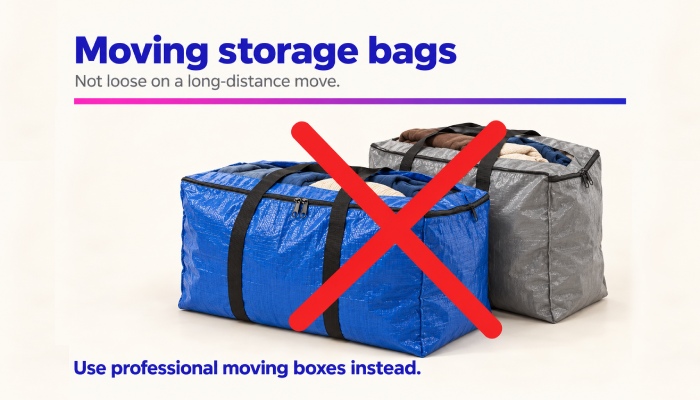
Moving Storage Bags? Use Boxes for Your Long-Distance Move.
Roadway Moving does not transport loose moving storage bags on long-distance moves. These soft-sided, zippered bags lack structural support, cannot be safely stacked, and are susceptible to tearing and damage during handling and transport, even when filled with clothes, linens, or pillows. Use professional moving boxes for folded clothing and bedding, and wardrobe boxes for hanging clothes. Already packed in bags? Contact your Move Coordinator before moving day to discuss repacking and any packing assistance you need.
Box Guide
Roadway Moving Box Types: What Goes in Each Box
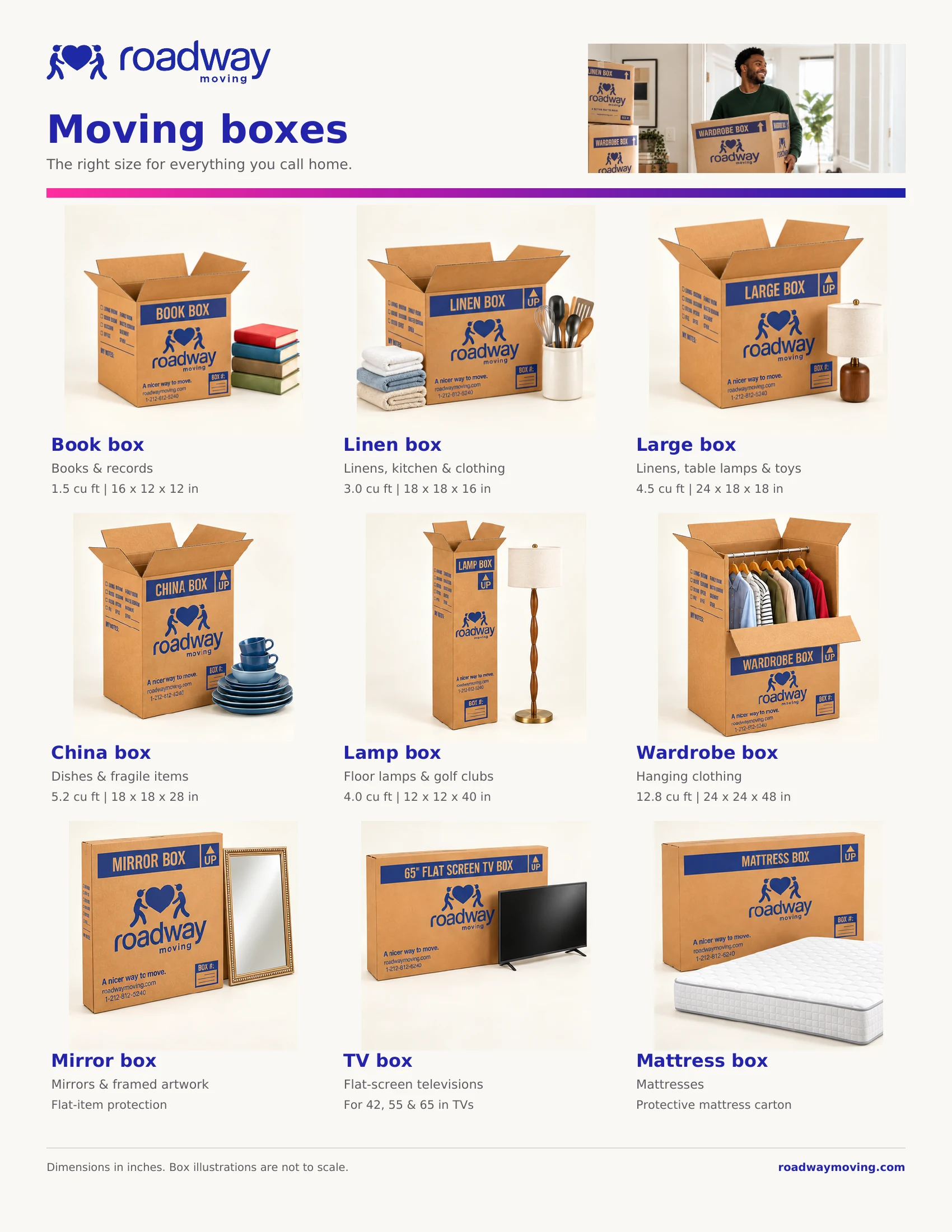
Roadway Moving offers nine moving box types, each sized for specific belongings:
- Book boxBooks and records1.5 cu ft · 16 × 12 × 12 in
- Linen boxLinens, kitchen items and clothing3.0 cu ft · 18 × 18 × 16 in
- Large boxLinens, table lamps and toys4.5 cu ft · 24 × 18 × 18 in
- China boxDishes and fragile items5.2 cu ft · 18 × 18 × 28 in
- Lamp boxFloor lamps and golf clubs4.0 cu ft · 12 × 12 × 40 in
- Wardrobe boxHanging clothing12.8 cu ft · 24 × 24 × 48 in
- Mirror boxMirrors and framed artworkFlat-item protection
- TV boxFlat-screen televisionsFits 42, 55 and 65 in TVs
- Mattress boxMattressesProtective mattress carton
Dimensions in inches. Box illustrations in the guide are not to scale.
The Real Comparison
What your boxes actually go through during a move
General, everyday boxes are engineered for small trips, like a single trip from a warehouse shelf to your house. Roadway’s professional boxes are engineered for something completely different.
Roadway Moving Boxes
Built for long-distance transit
- Virgin Cardboard: stronger, never weakened by moisture or prior use
- Double-Wall Construction: resists crushing under heavy stacking
- Uniform Sizing: stacks securely, prevents shifting in transit
- Designed for Weight: rated for the demands of long-distance hauling
Home Depot / Amazon Boxes
Built for one-trip delivery
- Recycled cardboard: weaker fibers, often already stressed from prior shipping
- Single-wall only: collapses under sustained weight after 24 to 48 hours
- Inconsistent sizing: creates unstable stacks that shift and crush during transit
- Rated about 32 to 40 lbs for single delivery: not engineered for stacking under load
- Damage to contents is not covered under Full Value Protection
Check the Stamp on the Box
Every professional box carries a Box Maker’s Certificate stamp that shows its strength. A typical Roadway box lists an edge crush test around 51 lbs and a gross weight limit near 20 lbs. Most general retail boxes are stamped for roughly 10 lbs, or carry no test stamp at all. If you cannot find a stamp, treat the box as suitable for lightweight items only.
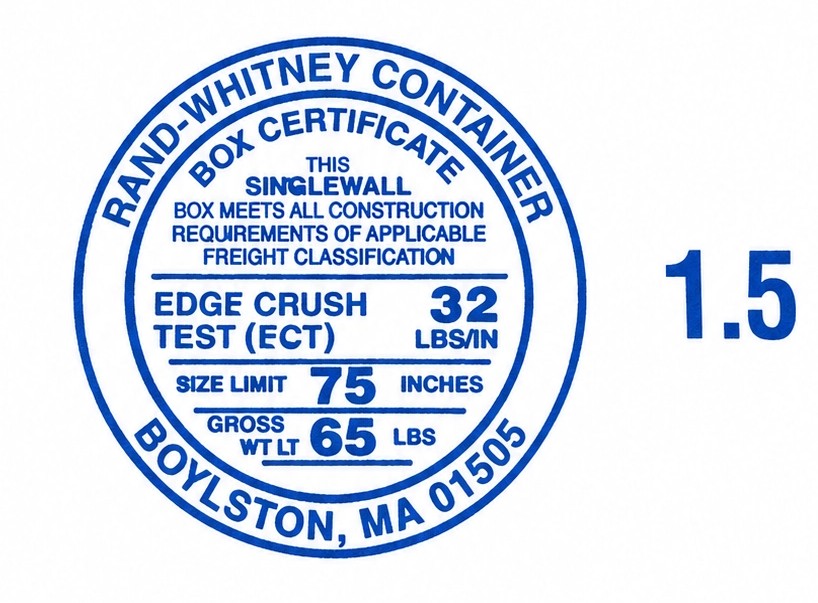
Quick check before you pack.Look on a bottom flap for the round certificate stamp. A higher edge crush test number means the box can take more stacking weight before it fails. No stamp means no strength guarantee.
Full Value Protection does not cover customer-packed boxes.Under federal moving regulations and Roadway Moving’s valuation policy, damage to items packed by the customer in customer-supplied materials, including retail and reused boxes, is excluded from Full Value Protection claims. The money saved on boxes is typically a fraction of what a single uncovered damage claim costs.
The Reality of Cheap Boxes on Long-Distance Moves
Picking up boxes from Home Depot or reusing Amazon delivery boxes can be a practical option for a local move across town. But long-distance moves place significantly more pressure on packing materials. Your boxes may stay packed for several days, remain stacked under heavy weight, and experience ongoing vibration and movement while in transit across state lines.
For interstate moves, consistency matters. Stronger boxes, even weight distribution, and stable stacking can help reduce the risk of crushing, shifting, or damage during the trip. Reused boxes can still work for some items, but they should be checked carefully for weakened corners, soft spots, moisture damage, or previous wear.
How bad are general retail boxes, really? In our own claims photos, a single move is enough to crush corners, soften walls, and split seams on a box that looked perfectly fine when it was packed. The contents do not survive that gap.
What Happens Inside the Truck
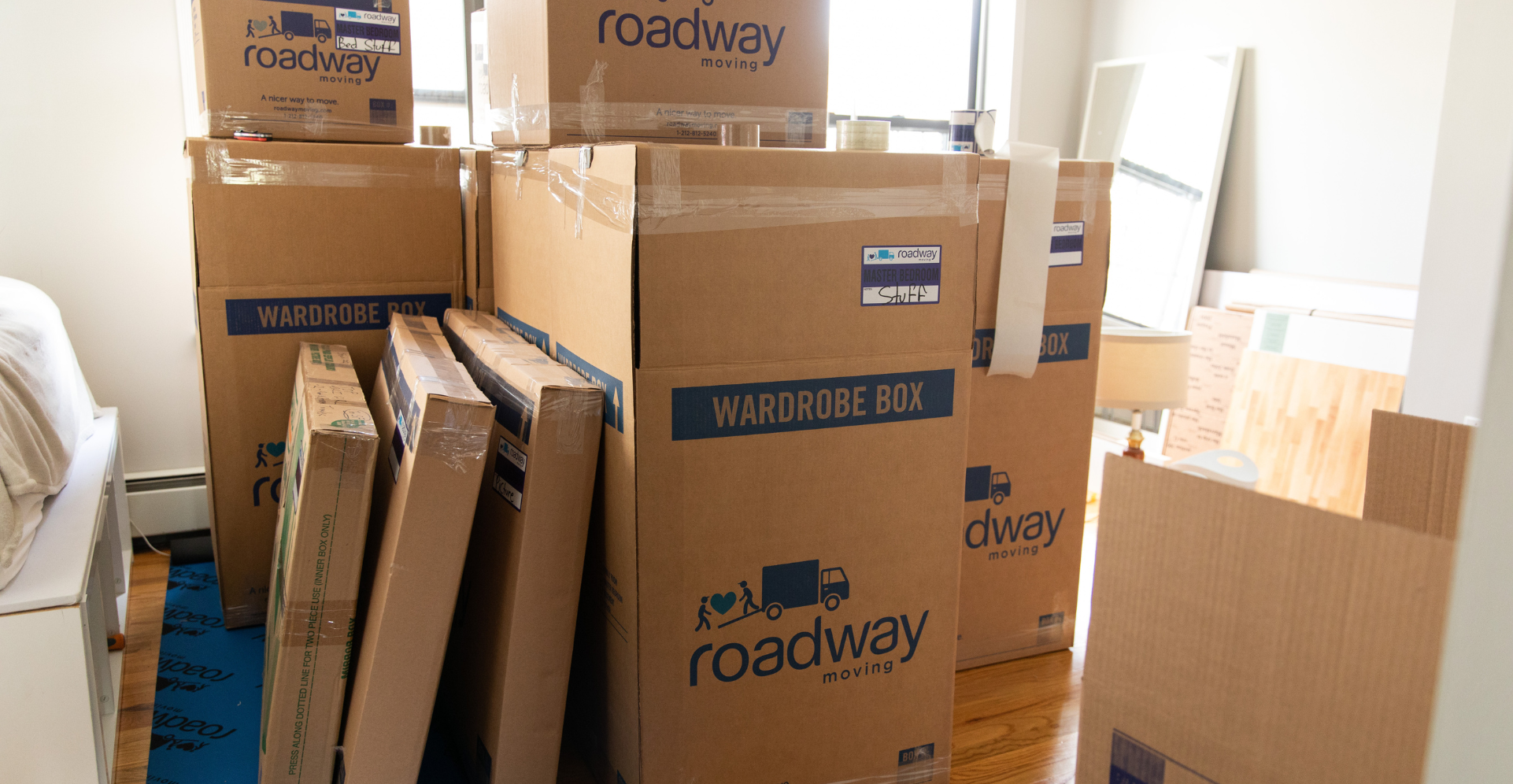
During a long-distance move, your belongings are stacked floor-to-ceiling inside a moving truck. The boxes at the bottom bear the weight of everything above them, often for days at a time. A retail box designed for a single trip from a warehouse to your doorstep is not engineered for this kind of sustained pressure. Over time, the walls buckle, the corners soften, and the contents inside are at risk.
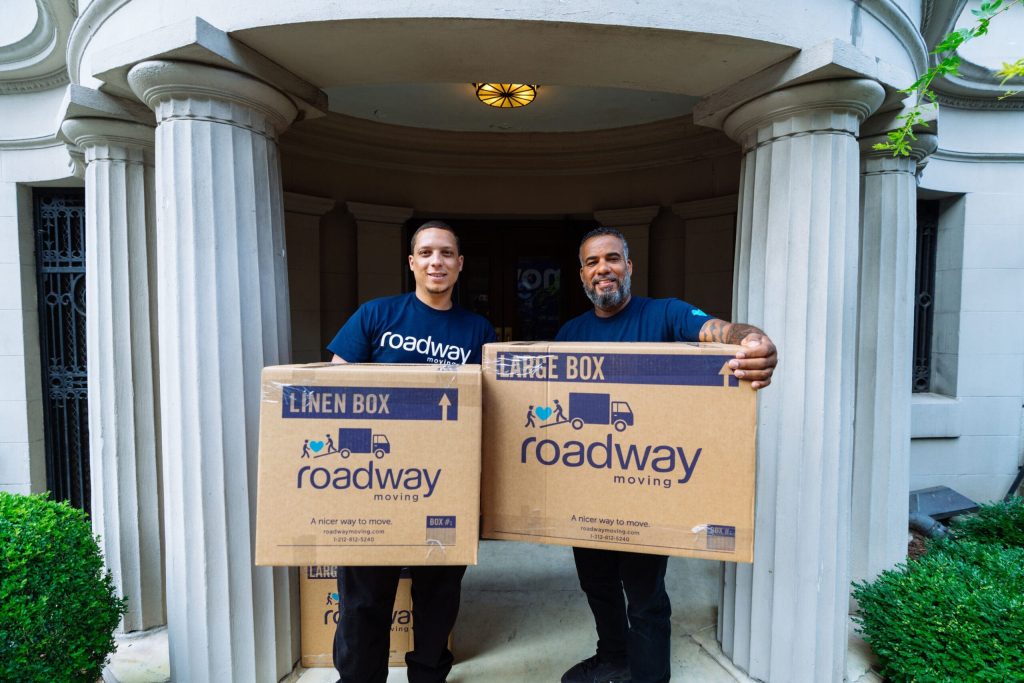
Cheap boxes cost more than you think.
Customers who use Home Depot or Amazon boxes for long-distance moves believe they are saving money. Roadway’s claims data tells a different story.
“We have seen it hundreds of times. A customer saves $80 on boxes, then files a $600 claim when the bottom gives out somewhere on I-95. And here is what makes it worse: if they packed those boxes themselves using retail materials, that damage is not covered under Full Value Protection. They saved nothing.”
Ross Sapir, Founder & President, Roadway MovingWhat “saving money” on boxes actually costs
A 2-bedroom long-distance move typically requires 40 to 60 boxes. Here is what the two choices actually look like when something goes wrong, which happens more often with retail boxes.
| Cost Item | Professional Boxes | Home Depot Boxes |
|---|---|---|
| Box cost (40 boxes, 2BR move) Pro: ~$7 avg Retail: ~$3 avg | $280 | $120 |
| “Savings” from choosing retail The number customers focus on | N/A | -$160 |
| Average uncovered damage claim Box failure: TV, dishes, lamp, artwork | Covered by FVP | $400 to $800+ |
| Full Value Protection eligibility If box failure causes damage | Eligible | Excluded |
| Real cost when something breaks | $280 | $680 to $1,080+ |
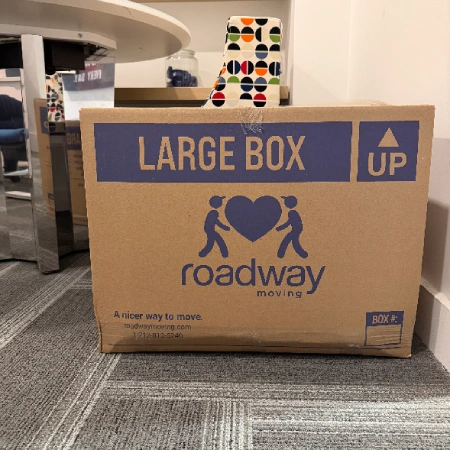
Before a Long-Distance Move
Take a little extra time to choose the right boxes for fragile, heavy, or high-value items. It is one of the simplest ways to protect your belongings before they ever leave your home. If you choose to use non-professional boxes, be aware that moving companies may not guarantee the safety of items packed in them.
How Roadway Moving Protects Your Belongings
At Roadway Moving, we use only virgin cardboard and double-wall boxes for our packing services. We know from experience how items look after a cross-country move in retail boxes, and we do not want that for our clients. We offer professional packing materials at competitive rates, and for long-distance moves, we strongly recommend using them. It is not about selling boxes. It is about protecting what matters to you.
Using Your Own Boxes?
Roadway Moving Policy: For interstate moves, we do not transport boxes packed by the customer in retail or reused materials unless the client specifically requests it and signs a release. Your relocation specialist will provide that release between your estimate and your booking, so there is nothing to sign on this page.
Planning a Long-Distance Move?
Roadway Moving can help with professional packing, moving, and storage options designed for moves that go beyond just a few miles.
Get Your Free Quote